Pagina 184
LAB > BOURNEFREE LIVE
Interpretation of the Delivery Scene (British English Version)
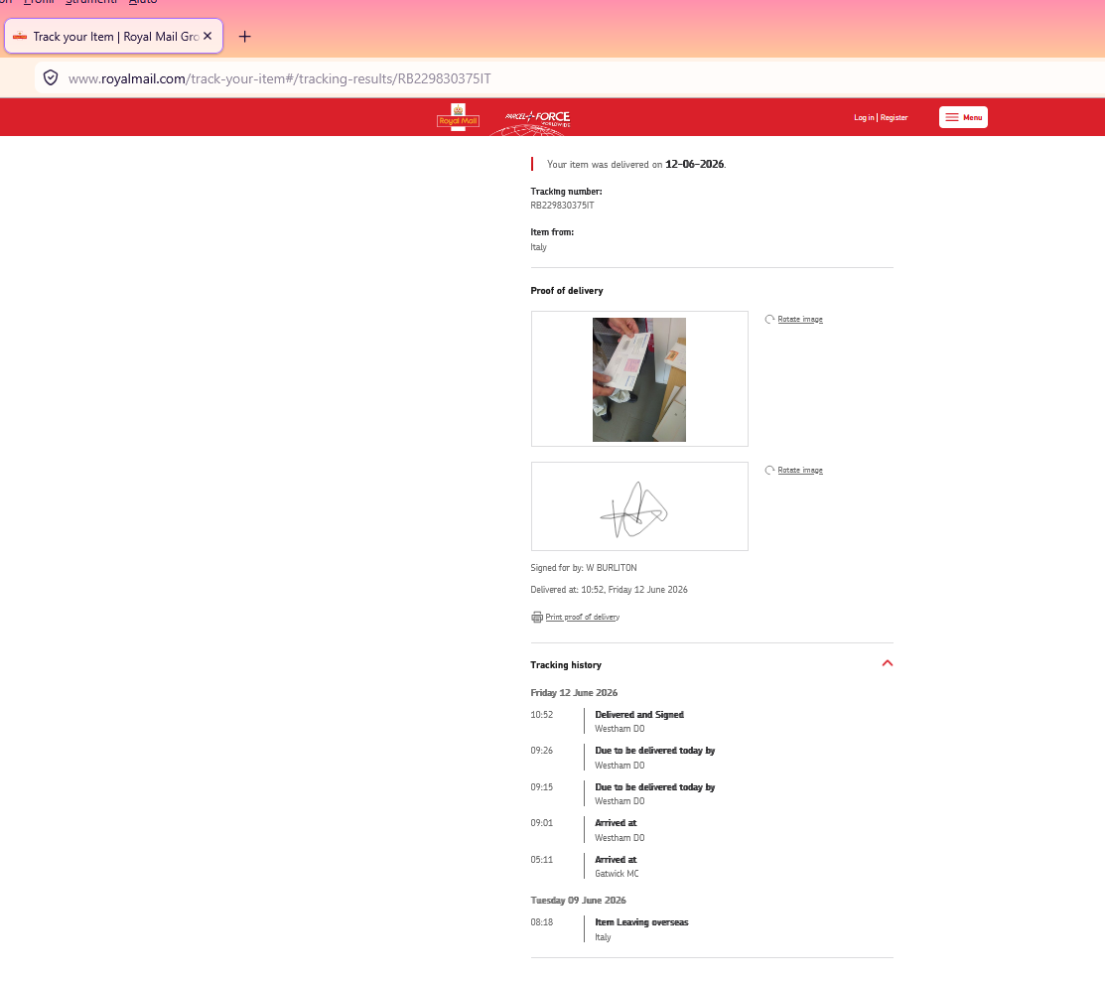
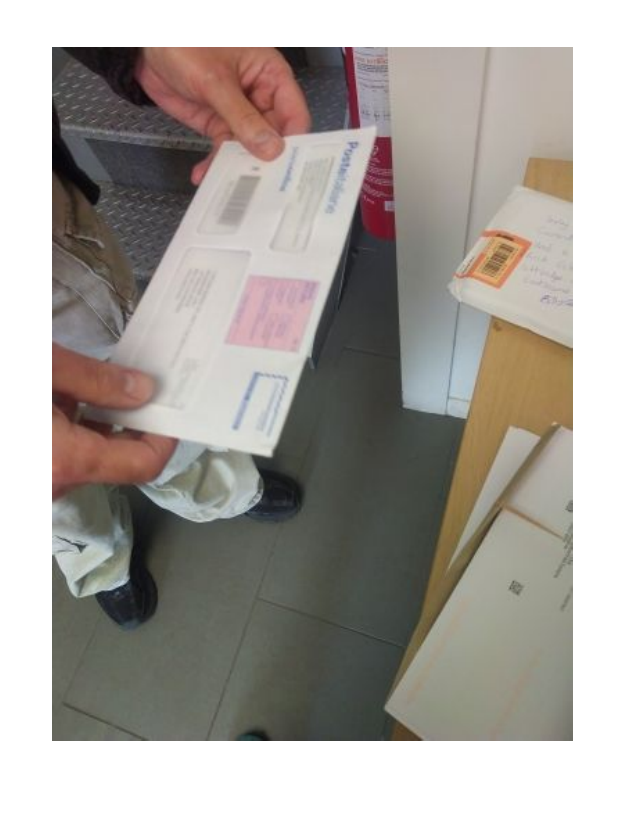
A close examination of the two images – the Royal Mail tracking screen and the photographic Proof of Delivery – reveals a scenario that goes well beyond an ordinary postal handover.
The individual depicted is not wearing Royal Mail uniform and appears to be standing inside a service or administrative area of the building. This makes it entirely plausible that he is an internal staff member who has just taken receipt of the international registered letter on behalf of the organisation.
The individual depicted is not wearing Royal Mail uniform and appears to be standing inside a service or administrative area of the building. This makes it entirely plausible that he is an internal staff member who has just taken receipt of the international registered letter on behalf of the organisation.
From this perspective, several behavioural and environmental cues become particularly telling.
1. The two‑handed grip: attention rather than routine
The envelope is held firmly with both hands, raised and angled in a way that allows the addressee details, labels and foreign markings to be clearly inspected.
This is not the typical gesture of a Royal Mail operative documenting a delivery:
- there is no rapid, procedural movement,
- no uniform,
- no sign of a standardised workflow.
Instead, the two‑handed grip suggests:
- careful inspection,
- curiosity,
- a brief interruption of routine,
- a moment in which the item is being consciously assessed before being passed on internally.
An Italian international registered letter, with its distinctive labels and formatting, naturally stands out within a predominantly domestic mail stream.
2. Body language: caution and awareness of formality
The subject’s posture is slightly withdrawn, with the arms extended and the fingers held in a controlled, deliberate manner.
This is not a relaxed gesture; it conveys attentiveness.
This is not a relaxed gesture; it conveys attentiveness.
Such body language is consistent with someone who:
- receives an unexpected formal communication,
- pauses to understand its origin,
- recognises that it is not routine correspondence,
- is aware that the item carries administrative weight.
It aligns well with the behaviour of an internal staff member responsible for handling incoming official documents.
3. The environment: a service corridor, not a reception area
The background provides further context:
- a wall‑mounted fire extinguisher,
- industrial metal stairs,
- a table with other items of internal post,
- the overall appearance of a back‑of‑house operational space.
This is clearly not a public‑facing reception or a customer service desk.
It is a technical or administrative corridor, where incoming mail is processed before reaching the relevant offices.
It is a technical or administrative corridor, where incoming mail is processed before reaching the relevant offices.
The juxtaposition of:
- an international registered letter,
- a utilitarian service environment,
- a staff member examining the item with evident focus,
creates an atmosphere of unexpected formality entering an otherwise routine operational setting.
4. Overall dynamic: a meaningful moment of internal receipt
Taken together, the scene conveys:
- not a distracted handover,
- not a mechanical postal procedure,
- not an anonymous transaction.
Rather, it suggests:
- an internal staff member taking charge of a formal document,
- a brief disruption of the usual workflow,
- a moment of assessment and administrative awareness,
- the perception that the envelope carries significance.
The international registered letter appears as a “non‑ordinary” item, and this is reflected in both the handling and the environment.
🎯 Final Summary
This is just an interpretation to be realistic, coherent and entirely defensible:
- The individual is not a Royal Mail postman.
- It is plausible that he is an internal staff member receiving the item on behalf of the organisation.
- His grip, posture and behaviour indicate attention, caution and formality.
- The environment reinforces the impression of an office unexpectedly confronted with a formal foreign communication.
- The overall impact is that of a letter perceived as official, serious and not easily disregarded.