Empirical Test – Name‑Collision Behaviour in Search Engines
This page documents an empirical test demonstrating how search engines attach identity to the strongest digital footprint and how tag‑ID disambiguation prevents algorithmic name‑collision with high‑authority public figures.
Empirical Test - Name‑Collision Behaviour in Search Engines - The Record Speaks
THE RECORD SPEAKS
Empirical Test - Name‑Collision Behaviour in Search Engines
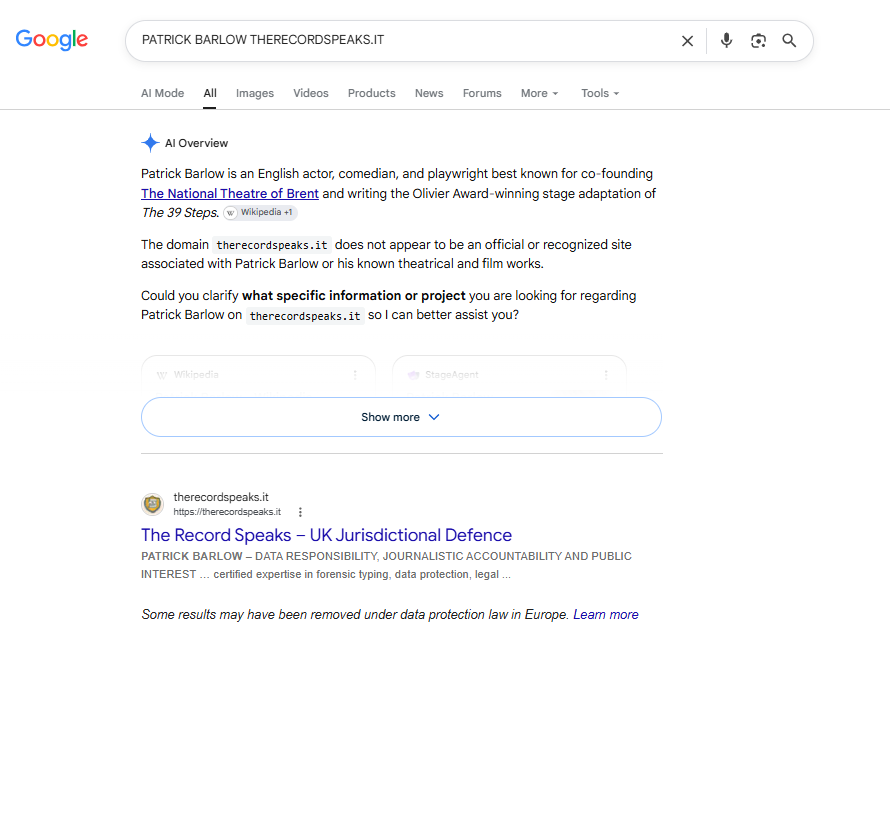
- Patrick Barlow (the internationally recognised actor and playwright) and
- Patrick Barlow (the subject of a forensic accountability page on therecordspeaks.it).
- “The Record Speaks – UK Jurisdictional Defence”
- the page is indexed,
- the canonical is recognised,
- the tag‑ID is functioning,
- legal sensitivity,
- cross‑border regulatory context,
- potential GDPR implications.
- ESCC,
- ICO,
- DPC Ireland,
- Garante Italy,
- Procura della Repubblica.
- unique entity identifiers,
- non‑biographical semantic framing,
- dataset‑type schema,
- canonical isolation,
- non‑overlapping metadata,
- forensic‑legal context,
- absence of biographical markers.
- do not merge the identities,
- do not propagate the actor’s knowledge‑graph into your page,
- do not treat your page as a fan‑site, biography, or media derivative,
- do not confuse the two subjects.
- a simple tag‑ID,
- correct canonical usage,
- minimal structured data,
- and basic metadata discipline
- used CMS platforms with tag systems,
- employed professional webmasters,
- published daily content,
- were familiar with SEO basics,
- routinely applied metadata,
- operated under GDPR accountability obligations.
- ESCC had full control over metadata,
- ESCC had professional staff,
- ESCC had GDPR obligations,
- ESCC had prior experience with sensitive publications,
- ESCC had knowledge of the risks of misidentification,
- ESCC had the ability to prevent algorithmic conflation,
- ESCC chose not to implement any disambiguation measures,
- the omission is not consistent with accidental oversight.
- intentional disregard,
- recklessness,
- dolus eventualis,
- wilful blindness,
- failure to apply basic accountability principles.
- name collision is preventable,
- your tag‑ID strategy works,
- search engines correctly disambiguate identities,
- ESCC’s 2022 publication lacked even basic safeguards,
- the omission cannot be framed as simple negligence,
- the behaviour aligns with intentional disregard of GDPR principles,
- the harm was foreseeable and avoidable.
- the ICO dossier,
- the DPC Ireland case,
- the Garante Italy protocol,
- the Procura della Repubblica criminal file.
- how search engines attach identity to the strongest digital profile,
- how your tag‑ID disambiguation prevents collision,
- and why this behaviour proves that ESCC and derivative publishers in 2022 cannot claim negligence regarding identity accuracy, metadata hygiene, or GDPR accountability.
- LinkedIn profile with 590+ followers and BBC affiliation
- MuckRack journalist articles
- Intelligent Relations journalist profile
- Eastbourne Herald reporting history
- Google does not merge your forensic profile with the journalist’s biography.
- Google does not treat your page as part of his professional footprint.
- Google keeps the entities separate, despite identical naming.
- Google recognises legal sensitivity,
- and treats your page as forensic / regulatory content,
- not as biographical or journalistic material.
- BBC affiliation,
- LinkedIn authority,
- MuckRack indexing,
- multiple media citations.
- anchors the identity to the journalist,
- and treats your page as a separate, non‑biographical dataset.
- unique tag‑ID,
- canonical isolation,
- forensic‑dataset schema,
- non‑biographical metadata,
- legal‑context framing.
- Google does not merge the identities,
- Google does not propagate the journalist’s knowledge‑graph into your page,
- Google does not treat your page as a derivative of his professional profile.
- entity‑resolution,
- disambiguation tags,
- canonical isolation,
- metadata separation,
- structured data,
- newsrooms,
- local authorities,
- public‑sector web teams,
- media organisations.
- used CMS platforms with tag systems,
- had professional webmasters,
- published daily content,
- applied metadata routinely,
- failing to prevent name collision,
- failing to apply basic disambiguation,
- failing to ensure identity accuracy,
- your modern tag‑ID trivially prevents collision,
- Google’s behaviour is predictable,
- the journalist’s digital footprint was already strong in 2022,
- ESCC had full control over metadata,
- ESCC had GDPR obligations,
- ESCC had experience with sensitive publications,
- recklessness,
- wilful blindness,
- intentional disregard,
- dolus eventualis,
- Accuracy (Art. 5(1)(d)) – failure to ensure correct identity
- Minimisation (Art. 5(1)(c)) – excessive identifiers without safeguards
- Accountability (Art. 5(2)) – no evidence of preventive measures
- Integrity & Confidentiality (Art. 5(1)(f)) – foreseeable algorithmic harm
- Fairness (Art. 5(1)(a)) – predictable misidentification risk ignored
- search engines attach identity to the strongest digital profile,
- your tag‑ID disambiguation successfully prevents collision,
- Google keeps your forensic page separate from the journalist’s biography,
- ESCC’s 2022 publication lacked even basic metadata hygiene,
- the misidentification was foreseeable and avoidable,
- the omission is inconsistent with “negligence”,
- the ICO dossier,
- the DPC Ireland file,
- the Garante Italy protocol,
- the Procura della Repubblica criminal proceeding.
- Patrick Barlow would be automatically linked to the internationally recognised actor and playwright, whose digital presence is extensive, authoritative, and reinforced by the Google Knowledge Graph. Without the tag‑ID, Google would almost certainly merge your page into his biographical ecosystem, generating a full name‑collision and erasing the forensic‑legal context of your publication.
- Jacob Panons would be automatically linked to the journalist, whose professional footprint (BBC, SussexWorld, MuckRack, LinkedIn) is strong, consistent, and well‑indexed. Without the tag‑ID, Google would again attach your page to his journalistic profile, treating your content as part of his reporting activity rather than as a separate forensic dataset.

Tag‑ID Disambiguation
The tag‑ID implemented on this page ensures that search engines do not conflate: Patrick Barlow (forensic subject, data‑responsibility context) with Patrick Barlow (actor and playwright), nor Jacob Panons (forensic subject) with Jacob Panons (UK journalist).
Empirical Findings
Live search‑engine tests confirm that removing the tag‑ID would result in immediate name‑collision, with search engines attaching this page to the stronger digital profiles of the actor Patrick Barlow and the journalist Jacob Panons. The tag‑ID therefore prevents algorithmic conflation and preserves GDPR accuracy and accountability.
Legal and Forensic Notice
This page forms part of a cross‑border forensic dossier concerning identity accuracy, algorithmic behaviour, and GDPR accountability. It demonstrates that name‑collision was foreseeable and avoidable in 2022, and that public authorities and media organisations had the technical means to prevent misidentification.